Soliloquy
Soliloquy, Part of: Seeing Studies, Artist’s book produced by “dOCUMENTA (13) in conjunction with Casco—Office for Art, Design and Theory and the institute for incongruous translation” 2011
“Initially, the artist followed Mir-Emad’s method, but since he was a bright and investigative individual, he later managed to modify Mir-Emad’s method according to his own taste and creativity.”
The above passage, describing Mohammad Reza Kalhor, was taken from the chapter on calligraphy in the book, Amoozesh-e Honar, and used as the point of departure for the following conversation. I asked Reza Abedini to correspond with me regarding his opinion on my reading of this paragraph. I continued the dialogue by interrupting his response and replying in the middle of it with a different color, then sent him the new text, to which he replied by writing between my response with a third color. We continued this exchange ten times, until the conversation had clearly come full circle. The components of each text grew farther apart with each addition until the obscurities in the dialogue had been clarified between the lines. What you read below is a written interview in which the temporal continuity of the conversation was broken in hopes of getting closer to each pronouncement.
The guide below illustrates the temporal order of the colors in each textual exchange:
Reza Abedini 1
Zeinab Shahidi 2
Reza Abedini 3
Zeinab Shahidi 4
Reza Abedini 5, Zeinab Shahidi 5 Zeinab Shahidi 6
Reza Abedini 7
Zeinab Shahidi 8
Reza Abedini 9
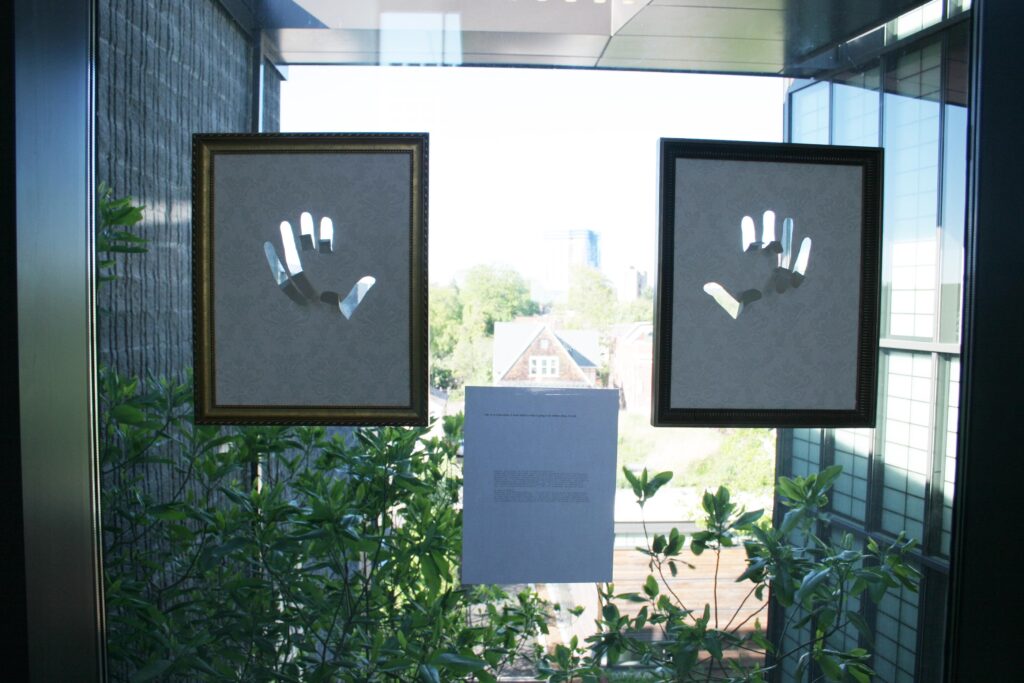
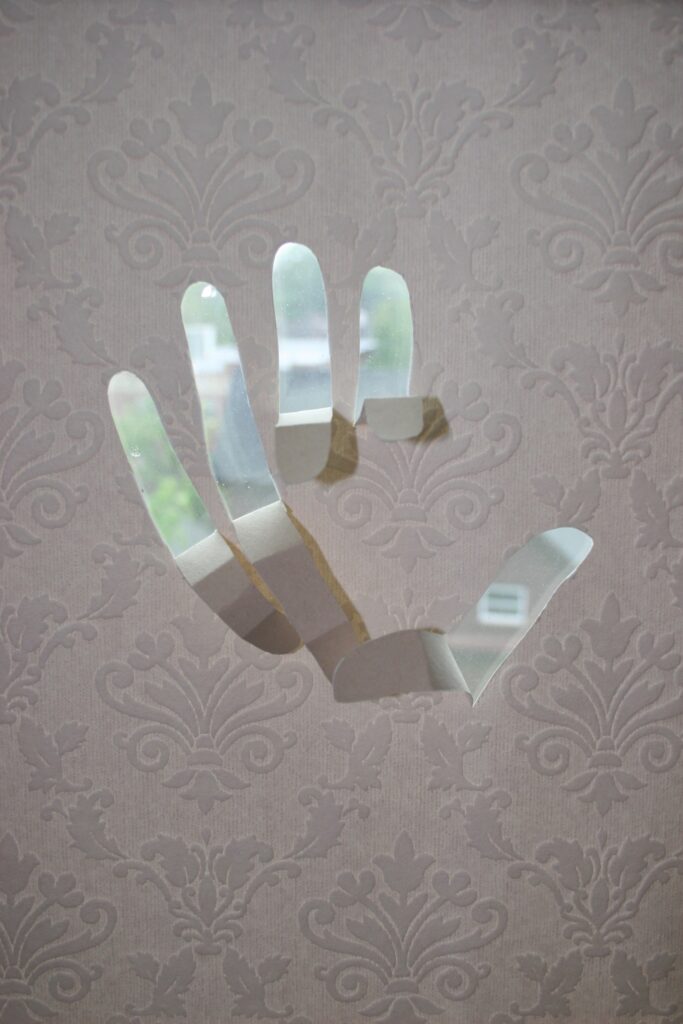
““
I invited my viewer to write about my work, but the work itself was supposed to be the text that he/she was going to write. I located the invitation (The Invitation: Ask /U/ to write about, A work which is what is going to be written about, A work) between the quotation marks that the fingers in the cut out hands make. The framed white wallpaper is over the glass of the frame; two hands are cut of from that. For me the quotation mark is one of those special moments in which the linguistic system works inversely. In language you have a sign to represent the notion of something including objects or behaviors in the real world. When we imitate the form of the quotation mark by our fingers what we do is create a behavior to represent signs and in fact we do the opposite of the linguistic process. This works exactly like writing about something, which the subject itself hasn’t created yet and it is going to be created by that text.